
Why tracking compliance in your entity management system is critical

Maintaining good standing across multiple entities requires visibility, accountability, and confidence that compliance obligations are being met. But staying on top of filing deadlines, reporting obligations, annual meetings, and license renewals is challenging.
When these activities aren’t tracked effectively, maintaining the visibility needed to ensure obligations are being met, becomes difficult for teams, often increasing risk. Organizations are moving beyond manual tracking methods and adopting purpose-built entity management software with integrated compliance tracking capabilities.
A dedicated compliance tracker helps legal and entity management teams centralize oversight, automate routine activities and gain greater confidence that critical obligations are being met.
What organizations must track to maintain entity compliance
Entity compliance refers to the ongoing legal, regulatory and governance requirements organizations must fulfill to keep their entities in good standing. Depending on the jurisdiction, this will likely include the following:
Annual reports and filings
Registered agent requirements
Board and shareholder meetings
Business license renewals
Corporate record maintenance
Tax-related filings
Governance obligations
Entity-specific compliance events
Organizations with many entities must oversee thousands of individual compliance tasks each year.
Why manual compliance tracking creates unnecessary risk
Spreadsheets and disconnected systems to manage regulatory and governance obligations may work for smaller portfolios but aren’t sufficient for large enterprises. Businesses operating a manual compliance tracking strategy may run into the following issues:
Limited visibility
When information isn’t centralized, it becomes difficult to identify upcoming deadlines, overdue activities or overall compliance status.
Reliance on individuals
Specific team members can sometimes become the only people with essential knowledge. If they leave the organization, this important knowledge can be lost.
Missed deadlines
Manual processes depend heavily on individual action and follow-through. As workloads increase, the likelihood of missed filings or overdue activities rises.
Difficult reporting
Providing updates to leadership often requires gathering information from multiple sources. Manually consolidating this data can prove difficult.
Why compliance tracking belongs inside your entity management system
The most effective way to manage compliance obligations is within the same systems that house your entity data. When compliance tracking is integrated within your entity management system, your organization can:
Create a single source of truth for governance and regulatory obligations
Eliminate duplicate data entry
Improve data accuracy
Streamline reporting
Increase visibility into entity-level activities
Reduce reliance on manual processes
Compliance stops being treated as a separate workflow, and organizations gain a complete view of both their entities and the obligations attached to them.
How GEMS Compliance Tracker helps teams stay in control
Computershare's Global Entity Management System, GEMS™, includes Compliance Tracker, a purpose-built workflow tool designed to simplify and strengthen entity compliance management.
Rather than juggling multiple tracking mechanisms, teams can centralize, automate, and manage critical activities within the same entity management platform. GEMS’ Compliance Tracker provides visibility into upcoming activities through list and calendar views, helping users identify deadlines and monitor progress. Status indicators and activity snapshots make it easier to oversee obligations across the organization. This means less time reviewing spreadsheets and more time making informed decisions based on accurate, actionable information.
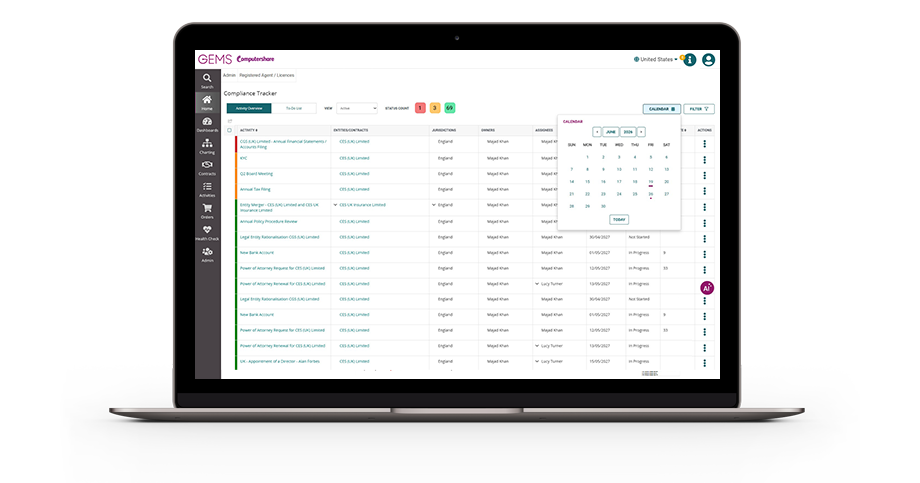
Teams can also create automated workflows, generate To-Do items and send reminders and queries to individuals responsible for completing activities. Compliance Tracker provides a collaborative workspace where users can upload related documents, communicate around tasks and keep information connected to the relevant activity.
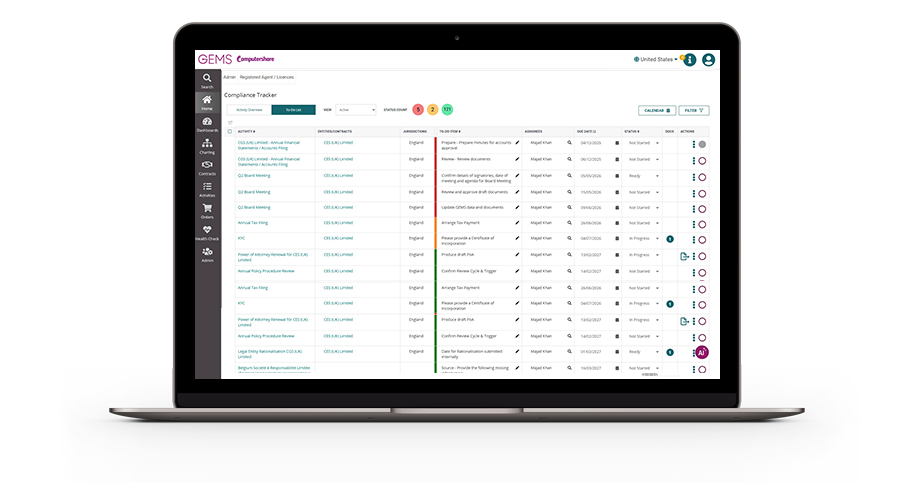
With GEMS’ Compliance Tracker, users can also customize dashboards and reporting views to meet their specific needs. Teams can create visual dashboards, filter activities by region and personalize how overdue items are reviewed and managed. This flexibility helps organizations create oversight processes that align with their governance structure and operating model.
See how GEMS can support your entity compliance
Ready to simplify entity compliance and gain greater control over your governance obligations?
See first-hand how GEMS’ Compliance Tracker can give your team greater visibility, stronger accountability and a more efficient approach to managing entity compliance.
Request a demo today and discover how GEMS can help transform compliance oversight from a manual process into a strategic advantage.
Frequently asked questions
What is GEMS’ Compliance Tracker?
Compliance Tracker is a tool within Computershare’s Global Entity Management System, GEMS, that helps organizations monitor, manage and document activities such as filings, renewals, governance obligations and regulatory deadlines. It provides visibility into upcoming tasks and helps ensure activities are completed on time.
Why is entity compliance important?
Entity compliance helps organizations maintain good standing, meet legal and regulatory obligations, support strong corporate governance and reduce the risk of penalties, operational disruption or reputational damage.
How can entity management software improve compliance?
Entity management software centralizes entity data and compliance deadlines in a single platform. This improves visibility, supports automation, strengthens reporting and helps organizations manage requirements more efficiently.