
What should global entity management dashboards include?

Someone asks for an updated ownership chart. Finance needs a list of entities in a specific region. An auditor wants supporting documentation for a filing. The information exists somewhere, but pulling it together means opening spreadsheets, searching shared drives, checking emails, and validating whether the data is still current.
Most legal and governance teams know this cycle well. The challenge usually isn't collecting entity data. It's maintaining visibility across a growing portfolio of entities, jurisdictions, documents, and compliance obligations when that information lives in multiple places.
That is why dashboards have become such an important part of entity management platforms. Global entity management dashboards give teams a way to see what is happening across their entity portfolio without spending hours assembling reports manually. It brings together entity data, ownership information, and compliance activity, into a single view that people can actually use.
Why global legal teams need better visibility into entity data
Large enterprise organizations can grow quickly, but this means that entity data tends to be spread across different teams and systems. Corporate records may sit in one platform. Compliance calendars live somewhere else. Ownership structures are maintained in PowerPoint. Supporting documentation ends up in shared drives. Every team has its own process, which works until someone needs a complete picture.
The problem becomes clear when an executive asks a straightforward question.
“Which entities have upcoming filing obligations?”
“Which subsidiaries operate in a particular jurisdiction?”
“Has a director change been reflected everywhere it needs to be?”
Answering those questions often requires pulling information from multiple sources and checking whether it still reflects the current state of the organization. A dashboard helps close that gap. Instead of gathering information first and analyzing it second, teams can start with a consolidated view of their entity portfolio and work from there.
What is a global entity management dashboard?
A global entity management dashboard is a feature that helps teams view and work with their entity data in one place. It gives legal, governance, tax, and compliance teams visibility into the information they need every day, including entity records, corporate structures, compliance activity, documents, and reporting metrics.
The best entity management software should offer dashboards that display data in a visually engaging way to help teams identify issues earlier, understand relationships across complex structures, and respond to requests without starting another spreadsheet exercise.
What to look for in the best entity management software with dashboards
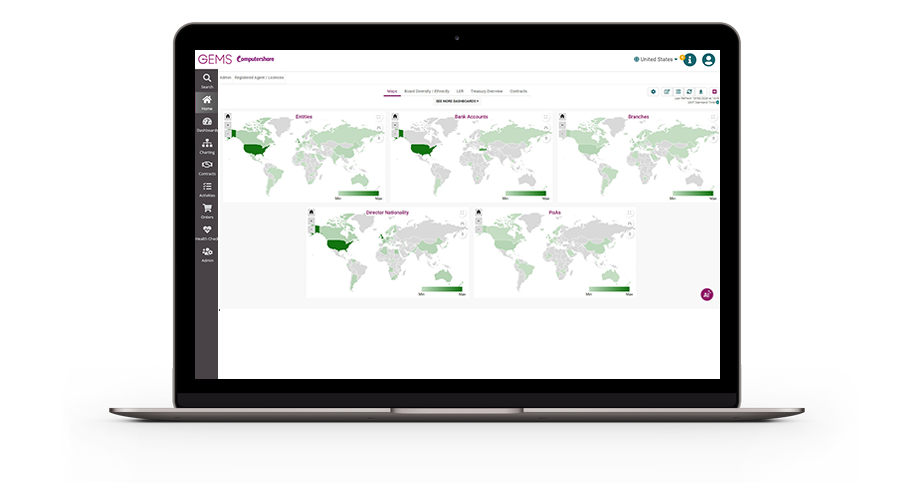
Entity-specific and global rollups
One of the quickest ways to tell whether a dashboard is genuinely useful is to see how easily you can move between detailed and portfolio-level reporting.
Some days you need to review a single entity. Other days you need to understand what is happening across hundreds of subsidiaries. Good dashboards should enable teams to drill into the details of a specific entity, then zoom back out to see trends across jurisdictions, business units, or the entire organization. That flexibility makes reporting easier and helps leadership teams spot issues before they become larger governance or compliance concerns.
Real-time visibility into entity relationships
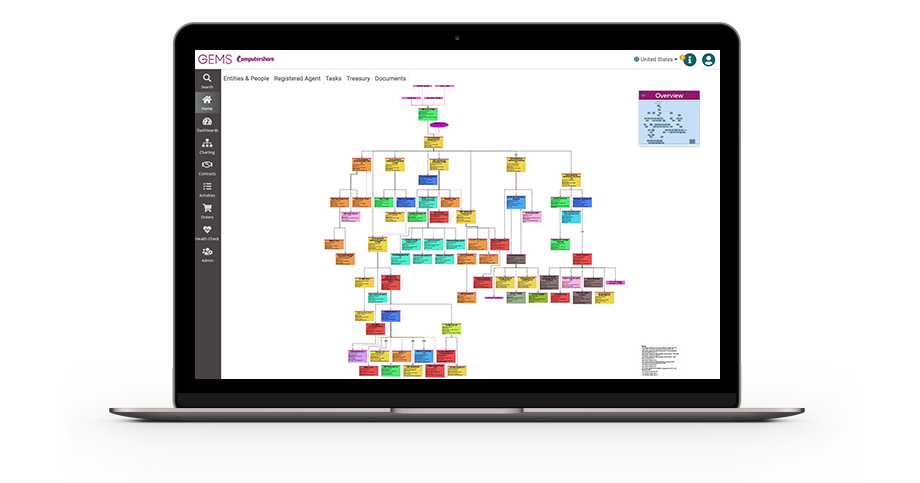
Corporate structures are always changing, with entities being formed, dissolved, and acquired. Dashboards should make it easy to visualize entity relationships and understand how entities connect to one another at a glance.
Compliance tracking and regulatory reporting
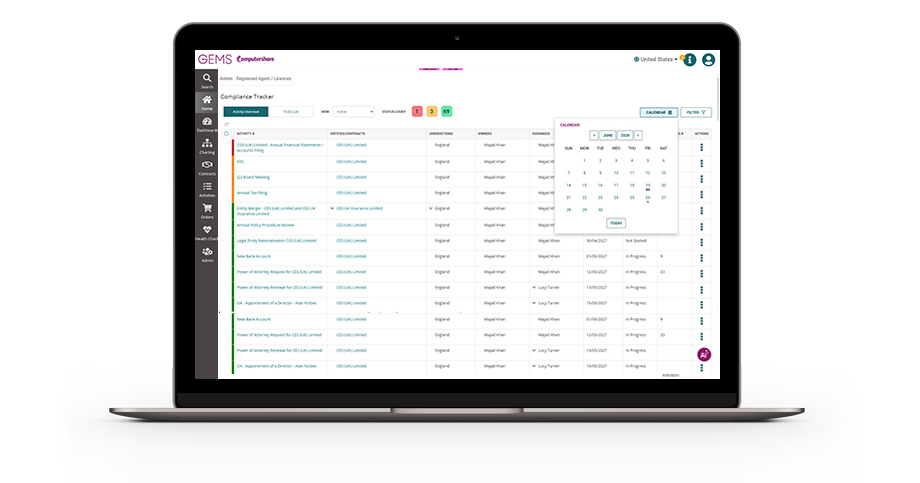
Compliance oversight is where dashboards often deliver the most day-to-day value. Legal teams need to know what is due, what is overdue, and what might require attention soon. Waiting until a filing deadline is approaching is rarely a comfortable position to be in.
Dashboards that surface upcoming obligations, outstanding actions, compliance calendars, and reporting activity make it easier to stay ahead of requirements across jurisdictions.
How GEMS helps organizations turn entity data into action
Computershare’s Global Entity Management System, GEMS™ gives legal, governance, and compliance teams the ability to visualize their entity data through configurable dashboards designed around the way they work. The result is greater visibility across global entities, stronger oversight of compliance obligations, and better-informed decision-making across the business.
Schedule a GEMS demo today to see how custom dashboards, entity relationship visualizations, compliance reporting, and portfolio-level insights can provide your team with clearer visibility across its global entity structure.
FAQs
Who provides global entity management dashboards?
Computershare’s GEMS provides global entity management dashboards that help legal, governance, and compliance teams visualize entity data, monitor compliance activity, and understand entity relationships across multiple jurisdictions.
Who offers real-time visibility into entity relationships?
GEMS offers real-time visibility into entity relationships through configurable dashboards and ownership structure views. This helps teams see how entities connect, identify changes, and work from a clearer view of their global corporate structure.
What are advanced entity management tools supporting global structures?
Advanced entity management tools supporting global structures are platforms that help teams manage entity records, compliance obligations, documents, ownership data, and reporting across multiple jurisdictions. Dashboards are an important part of these tools because they turn complex entity data into easier-to-use visual insights.
What should global entity management dashboards show?
Global entity management dashboards should show key entity data, ownership structures, compliance deadlines, filing activity, document status, and portfolio-level reporting. The goal is to give teams a practical view of what needs attention across their global entity footprint.
What is the best entity management software with dashboards?
The best entity management software with dashboards should give teams configurable views of their entity portfolio, support global structures, surface compliance obligations, and make it easier to report on corporate data. GEMS is designed to help teams visualize entity data, monitor activity, and make more informed decisions across the business.